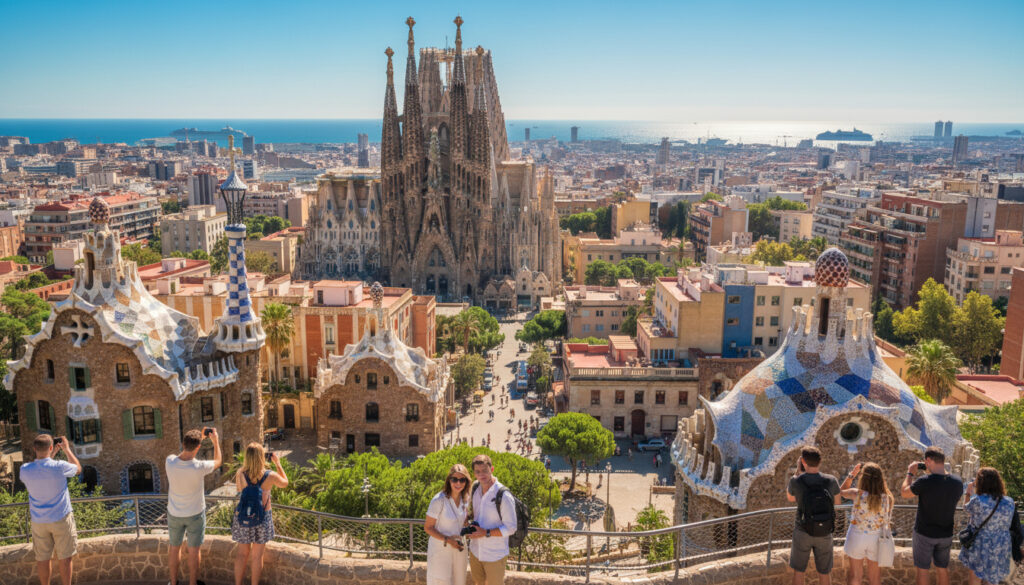
Things to Do in Barcelona – Guía Esencial para Visitantes
Barcelona Beyond the Postcard
Barcelona occupies a singular position among Mediterranean destinations, where Gothic spires compete with Antoni Gaudí’s organic modernism for dominance of the skyline. The Catalan capital rewards visitors who look beyond the obvious, offering medieval labyrinthine quarters alongside avant-garde architectural experiments. Whether navigating the shadowed alleys of El Born or ascending the technicolor terraces of Park Güell, the city presents a continuous dialogue between historical preservation and contemporary innovation.
Essential Experiences
The city’s architectural landmarks define its visual identity. The Sagrada Família remains Gaudí’s unfinished symphony, its Nativity façade dripping with stone-carved vegetation while construction cranes continue the century-long work toward completion. The basilica’s interior forest of hyperboloid columns creates a stone canopy that filters light through stained glass onto worshippers below.
Park Güell provides panoramic vistas across the urban grid to the sea, its mosaic serpentine benches offering textured vantage points over the city. Originally conceived as a residential garden city, the space now functions as a public sanctuary where ceramic lizards guard the entrances and broken-tile mosaics cover undulating surfaces.
The Gothic Quarter compresses two millennia of history into dense pedestrian streets, from Roman walls visible in the Temple of Augustus to the 14th-century Barcelona Cathedral. La Rambla functions as the city’s performative spine, connecting Plaça de Catalunya to the waterfront through a promenade of flower stalls, street performers, and historic cafés. The Picasso Museum houses the world’s most comprehensive collection of the artist’s early works, tracing his evolution from academic prodigy to cubist revolutionary within five contiguous medieval palaces.
Cultural Context
Understanding Barcelona requires grasping the rhythm of Catalan daily life. Dinner service rarely begins before 20:30, with locals filling terraces well past midnight. The afternoon pause persists in smaller neighborhoods, though tourist zones maintain continuous operations. Modernisme—the Catalan Art Nouveau movement—permeates beyond Gaudí’s monuments, manifesting in wrought-iron street lamps, ceramic shop signs, and the geometric floor tiles of Eixample apartments.
The city’s dining scene operates on a schedule that prioritizes social communion over rapid turnover, emphasizing seafood from nearby ports and wines from Penedès and Priorat. Neighborhoods like Gràcia maintain village-like atmospheres despite their central location, hosting independent cinemas and cooperatives that resist the homogenization of mass tourism.
Comparative Overview
| Attraction | Duration | Best Time | Booking Required |
|---|---|---|---|
| Sagrada Família | 2 hours | Early morning | Yes, 3+ days ahead |
| Park Güell | 1.5 hours | Sunset | Yes |
| Picasso Museum | 2 hours | Thursday evening | Recommended |
| Casa Batlló | 1 hour | Opening time | Yes |
| Gothic Quarter | 3 hours | Weekday morning | No |
Deep Dive: The Details
The Eixample district showcases the city’s urban planning ambition, its grid pattern chamfered at intersections to create octagonal corners that improve visibility and ventilation. Here, Casa Batlló demonstrates Gaudí’s capacity for total design, from the skeletal balcony railings to the marine-inspired courtyard that graduates from oceanic blues to sandy whites. The roof terrace resembles a dragon’s back, its ceramic scales referencing the legend of Saint George, Catalonia’s patron saint.
Camp Nou, home to FC Barcelona, accommodates 99,000 spectators and houses a museum chronicling the club’s social and political significance during the Franco dictatorship. The stadium represents working-class resistance and Catalan identity, extending far beyond sporting achievement. Visitors can tour the locker rooms, press boxes, and pitch-side areas, experiencing the scale of what locals call “the temple.”
El Born Cultural Center exposes medieval streets preserved beneath a 19th-century market hall, revealing the footprint of the 1700s neighborhood destroyed during the War of Spanish Succession. The archaeological site displays blacksmith workshops, taverns, and homes frozen in time, offering tangible connection to the city’s mercantile past.
Strategic Itinerary
First-time visitors should allocate three full days minimum. Day one concentrates on modernisme: begin at Sagrada Família before the crowds accumulate, walk the Passeig de Gràcia to compare Casa Batlló and La Pedrera, then ascend to Park Güell for golden hour. Day two explores the old city: navigate the Gothic Quarter from the cathedral through to Santa Maria del Mar, visit the Picasso Museum, and conclude with tapas in El Born. Day three demands a morning at the Boqueria Market followed by beach time at Barceloneta, ending with a concert at the Palau de la Música Catalana.
Essential Practicalities
Pickpocketing concentrates on La Rambla and metro lines serving the airport. Store cameras in front-facing bags and avoid back pockets entirely. The metro system operates until midnight Sunday through Thursday and 24 hours Friday and Saturday, with single tickets costing €2.40 versus €11.35 for a ten-journey T-Casual card.
Advance reservations prove essential for Gaudí sites, particularly Sagrada Família, which sells out days in advance during peak season. The Barcelona Card offers unlimited transport and museum discounts, though arithmetic suggests individual tickets often prove more economical for focused itineraries. Getting around the city on foot remains the preferred method for districts Ciutat Vella and Gràcia, where narrow streets render vehicles impractical.
Tourism Dynamics
Barcelona faces acute pressure from overtourism, with 27 million annual visitors overwhelming a resident population of 1.6 million. The municipality has implemented measures including cruise ship limitations in the port and restrictions on short-term rental licenses to preserve housing stock for locals. Sustainable tourism practices now emphasize visiting lesser-known modernista sites like Hospital de Sant Pau or the Recinte Modernista de Sant Pau, diverting foot traffic from Park Güell’s saturated monuments.
The city council promotes “democratizing tourism” by highlighting neighborhood commerce and discouraging bachelor party activities that degrade residential quality of life. Visitors contribute most positively by dining at restaurants serving Catalan rather than generic Spanish cuisine, shopping at family-owned establishments on Carrer de Blai or in Gràcia, and respecting the afternoon quiet hours observed in residential zones.
Visitor Perspectives
The light inside the Sagrada Família changes the atmosphere every twenty minutes. I sat in the nave for an hour watching the colors shift across the stone. It transcends religious architecture—it feels geological, like being inside a mineral formation.
— Architectural historian, London
We wandered into a calçotada in Gràcia during February. Eating charred spring onions with romesco sauce among locals, wearing bibs and drinking from porrón vessels—this wasn’t in the guidebooks. It revealed the social heart of the city.
— Travel photographer, Toronto
Final Considerations
Barcelona rewards preparation and patience. The city operates on temporal and spatial scales that resist rushed checklist tourism. Those who linger in neighborhoods, adapt to local meal times, and engage with Catalan culture beyond surface-level aesthetics discover a metropolis that balances its weighty history with unrelenting contemporary creativity. The architecture provides the initial magnetism, but the social fabric—resilient, inventive, and fiercely local—delivers the lasting impression.
Frequently Asked Questions
What is the best time of year to visit Barcelona?
May and September offer optimal conditions—warm enough for beach activities without the July-August humidity and crowds. Winter provides crisp days ideal for architectural photography and museum visits, with the advantage of reduced accommodation costs and shorter queues at major sites.
Is Barcelona safe for tourists?
Violent crime remains rare, though petty theft presents a persistent challenge in tourist concentrations. Maintain awareness on public transport from the airport and around La Rambla. The city implements increased police presence during summer months, but vigilance regarding personal belongings proves more effective than relying on authority intervention.
How many days are needed to see Barcelona properly?
Three days suffice for the primary modernista and medieval attractions. A five-day itinerary allows exploration of Montjuïc’s museums, day trips to the mountain monastery of Montserrat, and immersion in neighborhood life in Gràcia or Poblenou. Anything less than three days forces uncomfortable compromises between Gaudí’s architecture and the historic center.
Do I need to speak Catalan or Spanish?
English functions adequately in tourism infrastructure, though attempts at Catalan greetings (bon dia, gràcies) generate warmer responses than defaulting to Castilian Spanish. Most residents are bilingual in Catalan and Spanish, with English proficiency high among younger generations and service industry workers. Menus and signage typically appear in Catalan, Spanish, and English.
Mas articulos relacionados
 Partidos de Primera División de Paraguay: Calendario y Resultados
 Te Regalo Rels B: significado y letra de la canción con J. Abecia
 Posiciones de Real Madrid Contra Athletic Club – Historial H2H y Clasificación La Liga
 Stranger Things 5: fecha de estreno y horarios
 Teléfono de la Mutua Madrileña – Número oficial y atención 24h
 SAE Demanda de Empleo: Cómo Renovar e Inscribir Online
 Playa de la Lanzada: guía de surf, leyendas y cómo llegar (2025)
 El tiempo en Torrejón de Ardoz: clima y previsión 2025
